Creating the ideal baby sleep environment is one of the most impactful steps you can take to help your little one sleep better. As a sleep consultant certified through the Institute of Pediatric Sleep and Parenting, I've worked with hundreds of families who have transformed their baby's sleep simply by optimizing their nursery setup. The science is clear: environmental factors like room temperature, lighting, sound, and safe sleep practices play a crucial role in both sleep quality and safety.
In this comprehensive guide, we'll explore every aspect of the baby sleep environment--from the ideal room setup and temperature to darkness levels, white noise, safe sleep practices, and crib configuration. Whether you're preparing a nursery for a newborn or troubleshooting sleep issues with an older baby, understanding these environmental factors will set the foundation for peaceful nights and restful naps.
Why the Baby Sleep Environment Matters
Your baby's sleep environment directly impacts their ability to fall asleep, stay asleep, and sleep safely. Research published in the journal Sleep Medicine Reviews demonstrates that environmental factors significantly influence infant sleep patterns and duration.[1] The American Academy of Pediatrics (AAP) has established comprehensive safe sleep guidelines specifically because the sleep environment is so critical to infant safety.[2]
Unlike adults who can adapt to various sleeping conditions, babies are highly sensitive to their surroundings. A room that's too bright, too warm, too cold, or too stimulating can prevent your baby from settling into the deep, restorative sleep they need for healthy development. Conversely, an optimized baby sleep environment supports natural circadian rhythm development, reduces night wakings, and promotes longer stretches of consolidated sleep.
According to the National Institutes of Health (NIH), sleep plays a vital role in brain development during infancy, with specific sleep stages supporting memory consolidation, neural pathway formation, and physical growth.[3] Creating the right environment isn't just about convenience--it's about supporting your baby's development and keeping them safe.
Room Temperature: Finding the Sweet Spot
Maintaining the ideal temperature in your baby's room is essential for safe, comfortable sleep. The AAP and the National Sleep Foundation recommend keeping the room between 68-72°F (20-22°C) for optimal infant sleep.[4] This temperature range helps prevent overheating, which is a risk factor for Sudden Infant Death Syndrome (SIDS).
Why Temperature Matters for Baby Sleep
Babies cannot regulate their body temperature as effectively as adults. They have a higher surface-area-to-body-weight ratio, which means they lose heat more quickly. At the same time, they can overheat easily if over-bundled or in a room that's too warm. Research from the CDC indicates that overheating is associated with an increased risk of SIDS, making temperature control a safety priority.[5]
The ideal baby sleep environment maintains consistent temperature throughout the night. Temperature drops naturally as we sleep, and sudden fluctuations can cause night wakings. Consider these strategies for maintaining optimal temperature:
- Use a room thermometer: Don't rely on how the room feels to you. Place a thermometer near the crib to monitor actual temperature.
- Dress appropriately: A good rule of thumb is to dress your baby in one more layer than you would wear. A sleep sack or wearable blanket is safer than loose blankets.
- Check for overheating: Feel your baby's chest or back of neck. If they feel sweaty or hot, remove a layer.
- Avoid direct airflow: Position the crib away from heating vents, air conditioning units, and windows to prevent drafts.
Seasonal Temperature Adjustments
Summer and winter present different challenges for maintaining the ideal temperature. In summer, use a fan to circulate air (not pointed directly at baby) and opt for lightweight sleepwear. Research has shown that fan use in warm rooms can reduce SIDS risk by promoting air circulation.[6] In winter, use a appropriately weighted sleep sack and ensure heating doesn't cause the room to become too warm overnight.
Darkness: The Foundation of Good Sleep
Light is the primary cue for your baby's developing circadian rhythm--the internal clock that regulates sleep-wake cycles. Creating a dark sleep environment signals to your baby's brain that it's time to sleep by promoting melatonin production. Studies published in the Journal of Clinical Endocrinology and Metabolism confirm that light exposure suppresses melatonin, the hormone essential for sleep initiation.[7]
How Dark Should the Room Be?
For naps and nighttime sleep, the room should be dark enough that you can't see your hand in front of your face. This level of darkness may seem extreme, but it's particularly important for babies who are easily stimulated by visual input. Even small amounts of light can interfere with sleep, especially during the lighter stages of the sleep cycle.
Consider these recommendations for creating optimal darkness in your baby sleep environment:
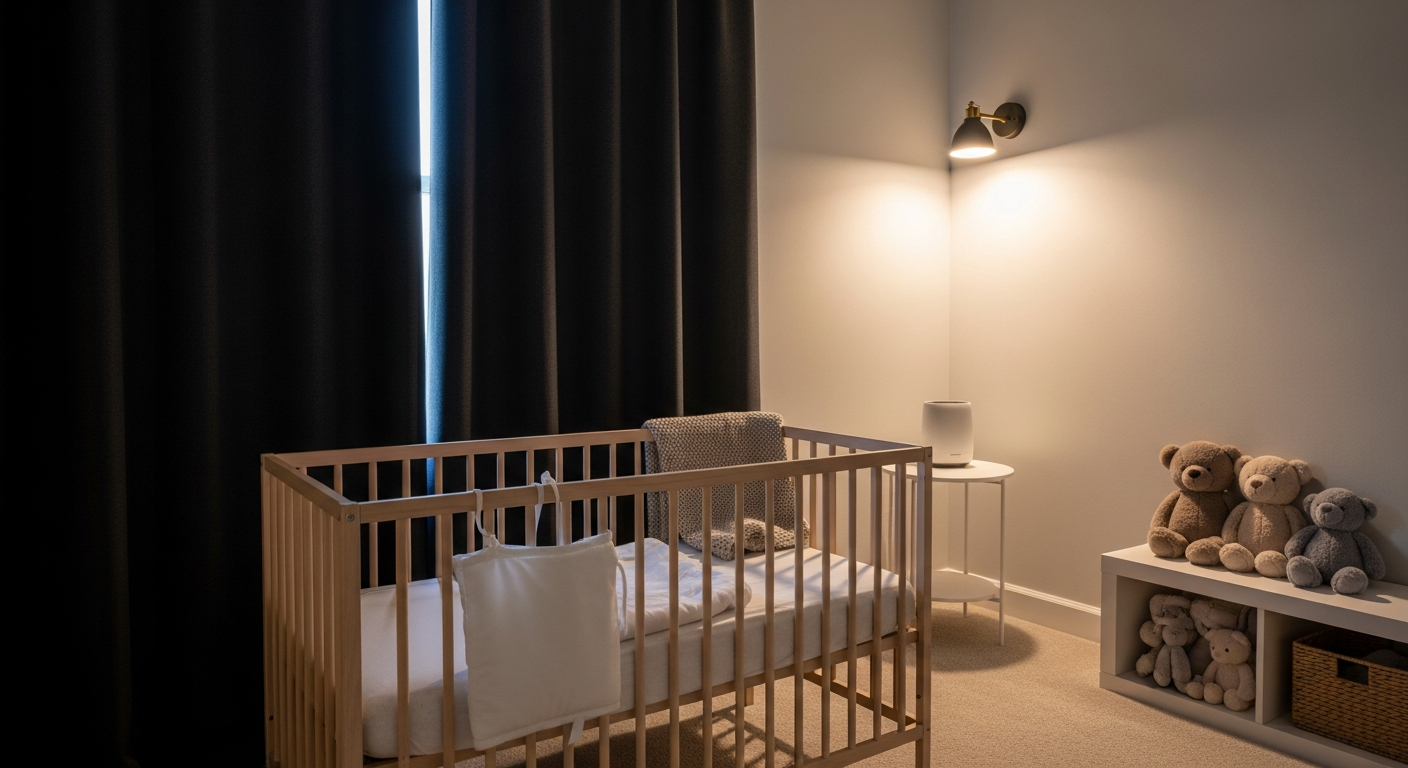
- Blackout curtains or shades: Invest in quality blackout window treatments. Look for options that block 100% of light and fit snugly against the window frame.
- Cover light sources: Put tape over indicator lights on monitors, humidifiers, and other devices. Even small LED lights can be stimulating.
- Use red or amber night lights: If you need light for nighttime feedings or diaper changes, use a dim red or amber light. These wavelengths don't suppress melatonin the way blue or white light does.
- Portable darkness: For travel, bring portable blackout shades or use black garbage bags and tape to darken unfamiliar rooms.
Morning Light for Circadian Rhythm
While darkness is essential during sleep times, exposure to natural light during awake periods is equally important. Bright morning light helps set your baby's circadian rhythm. Open the blinds upon waking and spend time in well-lit areas during the day. This contrast between light and dark helps babies distinguish day from night, which is particularly helpful for resolving day-night confusion in newborns.
White Noise: Creating a Consistent Sound Environment
White noise has become a staple in many nurseries, and for good reason. Research published in Archives of Disease in Childhood found that white noise helped 80% of newborns fall asleep within five minutes.[8] The consistent sound masks sudden noises that might startle your baby awake and creates a familiar sleep cue.
Why White Noise Works
The womb is a surprisingly loud environment--about as loud as a vacuum cleaner. White noise replicates this familiar sound, providing comfort and helping babies transition to the outside world. Beyond the newborn stage, white noise continues to be beneficial by:
- Masking household sounds: Doorbell rings, barking dogs, older siblings, and street noise can all disrupt sleep. White noise creates a consistent audio backdrop that makes these sounds less jarring.
- Creating a sleep association: The sound becomes a positive sleep cue, signaling to your baby's brain that it's time to sleep.
- Promoting longer sleep: By reducing disruptions during light sleep stages, white noise can help babies connect sleep cycles more easily.
Best Practices for White Noise
Not all white noise is created equal. Follow these guidelines for safe, effective use in your baby sleep environment:
- Volume: Keep the volume at 50-65 decibels--about the level of a running shower. The AAP recommends placing sound machines at least 7 feet from the crib and keeping volume low to protect developing ears.[9]
- Continuous sound: Choose a continuous, consistent sound rather than wave patterns, heartbeats, or music, which can be more stimulating.
- Placement: Position the sound machine across the room from the crib, not right next to your baby's head.
- Consistency: Use white noise for all sleep periods--naps and nighttime--to maintain a consistent sleep environment.
- Quality: Invest in a dedicated sound machine rather than using phone apps, which may have inconsistent volume or unexpected notifications.
Safe Sleep: The Non-Negotiable Foundation
No discussion of the baby sleep environment is complete without addressing safe sleep practices. The AAP's safe sleep guidelines are designed to reduce the risk of SIDS and other sleep-related infant deaths. These recommendations are based on extensive research and should be followed for every sleep, including naps.[10]
The ABCs of Safe Sleep
The AAP summarizes safe sleep with three simple letters:
- Alone: Baby should sleep alone on their own surface, not in a bed with parents or siblings.
- Back: Always place baby on their back for every sleep until age 1.
- Crib: Use a firm, flat surface like a safety-approved crib, bassinet, or play yard with a tight-fitting sheet.
What Doesn't Belong in the Crib
A safe crib is a bare crib. The following items should never be in your baby's sleep space:
- Pillows
- Blankets (use a wearable blanket instead)
- Bumper pads (including mesh bumpers)
- Stuffed animals or toys
- Positioners or nests
- Loose bedding of any kind
The CDC reports that approximately 3,400 babies die suddenly and unexpectedly each year in the United States, and many of these deaths are associated with unsafe sleep environments.[11] While these statistics are sobering, following safe sleep guidelines significantly reduces risk.
Room Sharing vs. Bed Sharing
The AAP recommends room sharing (having baby sleep in the parents' room but on a separate surface) for at least the first 6 months, ideally the first year. Room sharing has been shown to decrease SIDS risk by as much as 50%.[12] However, the AAP specifically advises against bed sharing (having baby sleep in the same bed as parents), as this increases the risk of suffocation and SIDS.
If you're struggling with sleep and considering bed sharing out of desperation, please reach out for support. As a consultant certified through the Institute of Pediatric Sleep and Parenting, I can help you find safe solutions to your sleep challenges. Schedule a free discovery call or call us at (213) 935-0769 to discuss your situation.
Crib Setup: Creating the Ideal Sleep Space
Your baby's crib is where they'll spend a significant portion of their first year. Setting it up properly is essential for both safety and sleep quality.
Choosing the Right Crib
Look for a crib that meets current safety standards. The Consumer Product Safety Commission (CPSC) has specific requirements for cribs sold in the United States:[13]
- Slat spacing no more than 2 3/8 inches apart
- Firm, tight-fitting mattress with no more than two finger widths between mattress and crib side
- No drop sides (these have been banned since 2011)
- Sturdy construction with no loose or missing hardware
Mattress Selection
The mattress is one of the most important components of your baby sleep environment. Choose a mattress that:
- Is firm: A baby mattress should feel much firmer than an adult mattress. If you press on it, it should immediately return to its flat shape.
- Fits snugly: There should be no gaps between the mattress and crib sides where baby could become trapped.
- Has a waterproof cover: This makes cleaning easier and extends the life of the mattress.
- Meets safety standards: Look for CPSC certification and GREENGUARD Gold certification for low emissions.
Crib Placement in the Room
Where you place the crib matters for both safety and sleep quality:
- Away from windows: Avoid placing the crib near windows where curtain cords pose a strangulation hazard and temperature fluctuations occur.
- Away from heaters and vents: Direct hot or cold air can be uncomfortable and unsafe.
- Clear of hanging objects: Mobiles, pictures, and shelves should not be within reach of the crib.
- Against a wall: For stability, and away from other furniture that an older baby could use to climb out.
Creating an Optimal Environment for Naps vs. Nighttime
While the core elements of the baby sleep environment remain consistent, there are some considerations specific to naps and nighttime sleep.
Nap Environment
Naps should occur in the same environment as nighttime sleep whenever possible. This consistency helps reinforce sleep associations and signals to your baby that it's time to sleep. Key considerations for naps include:
- Same darkness level as nighttime (yes, even for daytime naps)
- Same white noise
- Same sleep sack or swaddle
- Abbreviated version of bedtime routine (5-10 minutes)
Nighttime Environment
For nighttime sleep, create conditions that support long stretches:
- Complete darkness from bedtime until morning wake time
- White noise running continuously all night
- Minimal interaction during night wakings (keep lights off, voices quiet)
- Consistent temperature throughout the night
Common Baby Sleep Environment Mistakes to Avoid
Even well-intentioned parents sometimes make environmental choices that inadvertently disrupt sleep. Here are common mistakes and how to correct them:
1. Room Too Bright
The problem: Light streaming through windows or from night lights interferes with melatonin production.
The solution: Invest in blackout curtains and eliminate all unnecessary light sources. Use only dim red/amber lighting when needed.
2. Inconsistent Environment
The problem: Putting baby to sleep in different locations or with different conditions creates confusion.
The solution: Make the crib the primary sleep location for all sleep. Use the same white noise, darkness, and routine consistently.
3. Room Too Warm
The problem: Overheating is a SIDS risk factor and causes restless sleep.
The solution: Keep the room between 68-72°F and dress baby appropriately. Skip the blankets and use a wearable blanket instead.
4. Stimulating Nursery Decor
The problem: Bright colors, busy patterns, and mobiles above the crib can be overstimulating.
The solution: Keep the sleep area calm and neutral. Save stimulating items for play areas.
5. Unsafe Sleep Products
The problem: Products marketed as sleep aids (positioners, nests, inclined sleepers) can be dangerous.
The solution: Stick with AAP-recommended sleep surfaces only. When in doubt, consult your pediatrician or a certified sleep consultant.
Troubleshooting Environment-Related Sleep Issues
If your baby is struggling with sleep despite your best efforts, the environment may be contributing. Here's how to troubleshoot common issues:
Baby Wakes at the Same Time Every Night
Consider environmental factors that change at that time: heating clicking on or off, early morning light creeping in, or neighbors' routines. Address the specific trigger.
Baby Only Naps for 30-45 Minutes
Short naps often indicate difficulty transitioning between sleep cycles. Ensure the room is completely dark and white noise is running. Some babies need even darker conditions for naps than nighttime.
Baby Fights the Crib
If your baby seems to dislike the crib, spend positive awake time there during the day. Place them in the crib for a few minutes with a toy while you're nearby. Build positive associations with the space.
Baby Wakes with the Sun
Even small amounts of early morning light can trigger early wakings. Check for light leaks around curtains and address them with velcro, magnets, or better-fitting window treatments.
When to Seek Professional Help
While optimizing the baby sleep environment can resolve many sleep issues, some families need additional support. Consider reaching out to a certified pediatric sleep consultant if:
- You've optimized the environment but sleep issues persist beyond 2-3 weeks
- Your baby has significant sleep associations that prevent independent sleep
- Sleep deprivation is affecting your health, relationships, or ability to function
- You're unsure whether your baby's sleep patterns are normal for their age
- You need personalized guidance on sleep training methods that align with your parenting style
At Rose Sleep Co, we provide comprehensive sleep support tailored to your family's unique needs. Book a free discovery call to learn how we can help, or call us directly at (213) 935-0769.
Creating Your Baby's Ideal Sleep Environment: A Checklist
Use this checklist to ensure you've addressed all aspects of the optimal baby sleep environment:
Temperature
- Room temperature between 68-72°F
- Room thermometer near the crib
- Appropriate sleepwear/sleep sack
- No direct drafts on crib
Darkness
- Blackout curtains installed and light-tight
- No indicator lights visible in room
- Red/amber night light for nighttime care (optional)
Sound
- White noise machine positioned 7+ feet from crib
- Volume at 50-65 decibels
- Continuous sound (not intermittent patterns)
- Runs for all sleep periods
Safety
- Firm, flat mattress that fits snugly
- No pillows, blankets, bumpers, or toys in crib
- Baby placed on back for all sleep
- Crib meets current safety standards
Crib Placement
- Away from windows
- Away from heaters and vents
- No hanging objects within reach
- Against a wall for stability
The Bottom Line on Baby Sleep Environment
The baby sleep environment you create for your little one sets the stage for healthy sleep habits. By optimizing temperature, darkness, sound, and safety, you're giving your baby the best possible conditions for restorative sleep. Remember that consistency is key--the same environment for every sleep helps your baby's brain recognize sleep cues and settle more easily.
If you've addressed environmental factors and still struggle with sleep, you don't have to figure it out alone. Professional support from a certified pediatric sleep consultant can make all the difference. Reach out today to start your journey toward better sleep for the whole family.
References
- 1. Mindell, J. A., et al. (2010). Sleep and Sleep Ecology in the First 3 Years. Sleep Medicine Reviews, 14(2), 89-96. https://pubmed.ncbi.nlm.nih.gov/19631566/
- 2. American Academy of Pediatrics. (2022). Safe Sleep Recommendations. https://www.aap.org/en/patient-care/safe-sleep/
- 3. National Institutes of Health. (2022). Brain Basics: Understanding Sleep. https://www.ninds.nih.gov/health-information/public-education/brain-basics/brain-basics-understanding-sleep
- 4. Sleep Foundation. (2023). Best Temperature for Baby Sleep. https://www.sleepfoundation.org/baby-sleep/best-temperature-for-baby-sleep
- 5. Centers for Disease Control and Prevention. (2023). Sudden Unexpected Infant Death and Sudden Infant Death Syndrome. https://www.cdc.gov/sids/about/index.html
- 6. Coleman-Phox, K., et al. (2008). Use of a Fan During Sleep and the Risk of Sudden Infant Death Syndrome. Archives of Pediatrics and Adolescent Medicine, 162(10), 963-968. https://pubmed.ncbi.nlm.nih.gov/18838649/
- 7. Gooley, J. J., et al. (2011). Exposure to Room Light before Bedtime Suppresses Melatonin Onset. Journal of Clinical Endocrinology and Metabolism, 96(3), E463-E472. https://pubmed.ncbi.nlm.nih.gov/21193540/
- 8. Spencer, J. A., et al. (1990). White Noise and Sleep Induction. Archives of Disease in Childhood, 65(1), 135-137. https://pubmed.ncbi.nlm.nih.gov/2301975/
- 9. Hugh, S. C., et al. (2014). Infant Sleep Machines and Hazardous Sound Pressure Levels. Pediatrics, 133(4), 677-681. https://pubmed.ncbi.nlm.nih.gov/24590747/
- 10. Moon, R. Y., et al. (2022). Sleep-Related Infant Deaths: Updated 2022 Recommendations for Reducing Infant Deaths in the Sleep Environment. Pediatrics, 150(1), e2022057990. https://publications.aap.org/pediatrics/article/150/1/e2022057990/188304/
- 11. Centers for Disease Control and Prevention. (2023). Data and Statistics for SIDS and SUID. https://www.cdc.gov/sids/data/index.html
- 12. Task Force on Sudden Infant Death Syndrome. (2016). SIDS and Other Sleep-Related Infant Deaths: Updated 2016 Recommendations. Pediatrics, 138(5), e20162938. https://pubmed.ncbi.nlm.nih.gov/27940804/
- 13. Consumer Product Safety Commission. (2023). Safe Sleep: Cribs and Infant Products. https://www.cpsc.gov/Safety-Education/Safety-Guides/cribs
Need Help with Your Baby's Sleep?
Every child is different. Get a personalized sleep plan tailored to your family's unique needs. Call or text Rose directly at (213) 935-0769 for a free 15-minute discovery call.