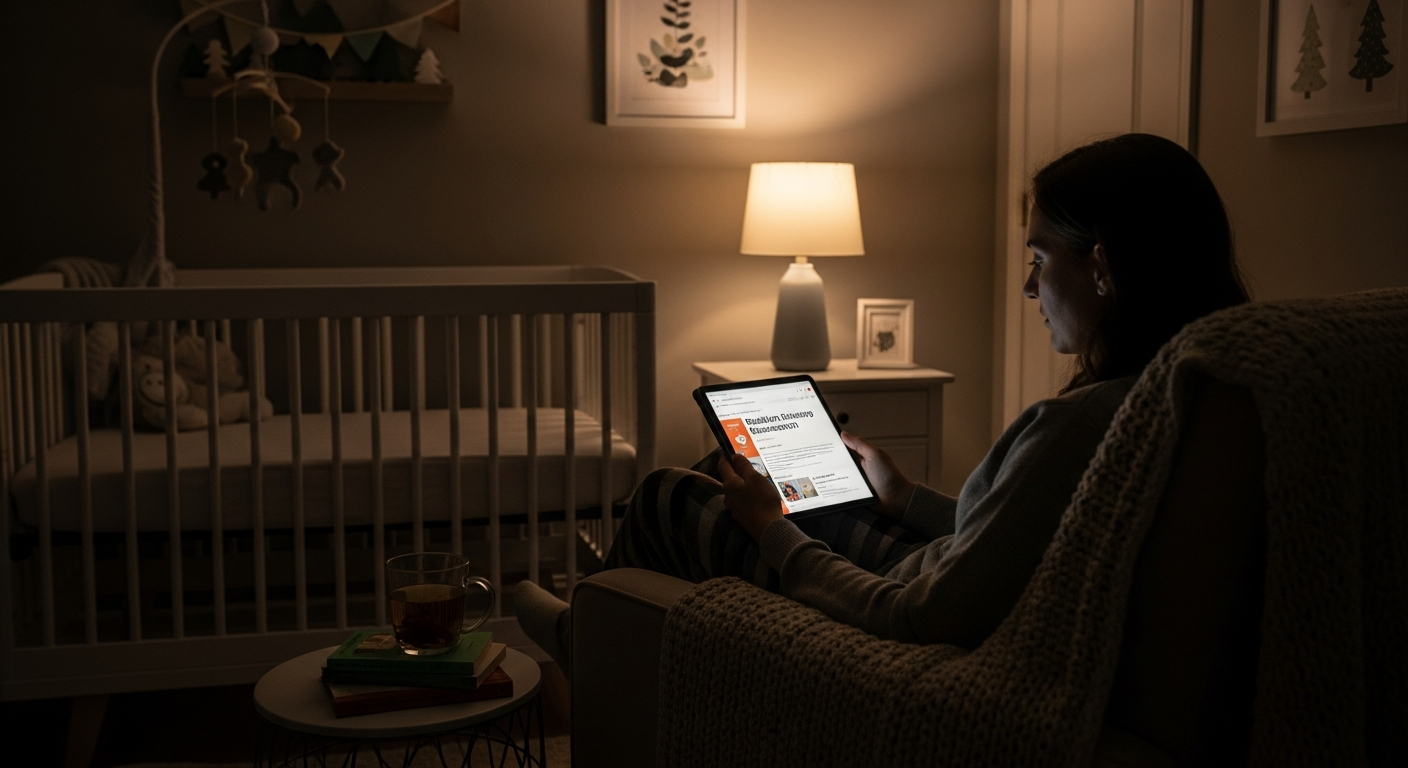
If you've ever searched "baby won't sleep" at 2:47 a.m. with one hand while rocking a warm, breathing human with the other—this article is for you.
And if you've ever closed Reddit feeling worse than when you opened it, same.
This is the story of how I got kicked off a popular Reddit sleep training sub—because I pushed back on a narrative that I believe quietly harms exhausted mothers: the idea that any sleep association will inevitably become a problem, and that if you don't "fix it" early, you're setting yourself up for failure.
Spoiler alert: the science does not support that level of fear.
This article is not here to convince you to sleep train—or not sleep train. It's here to give you permission to stop panicking if something is currently working, and to understand when sleep habits actually matter, why some associations turn into issues and others don't, and how internet culture often oversimplifies infant sleep in ways that real families pay for emotionally.
What Actually Happened
A parent posted something incredibly common:
"I rock my baby to sleep every night, but they sleep just fine. Do I have to sleep train, or is it okay to keep doing this?"
A moderator replied with something along the lines of:
"Will you rock them to sleep when they are 2? 4? 5?"
That tone matters.
Because embedded in that response is a familiar message many mothers hear constantly: If you don't stop now, you'll regret it later.
I responded factually. I said, in essence:
- Yes, some parents will rock their children to sleep well into toddlerhood—and they're not broken.
- Not every family experiences that as a problem.
- If something is working and no one is distressed, there is no scientific reason to intervene.
That debate ended with me being removed from the sub.
And honestly? I'm okay with that—because it exposed something important.
The Internet Treats Infant Sleep Like a Moral Failing
One of the most damaging myths in online sleep spaces is the idea that infant sleep is a binary:
- Independent sleep = good parenting
- Supported sleep = future disaster
But infant sleep does not work like that neurologically, developmentally, or emotionally.
Sleep research consistently shows that night waking, sleep transitions, and variability are biologically normal in infancy, especially in the first year of life.[1][2] Yet online discourse often frames these normal patterns as problems that must be fixed immediately—or else.
This creates unnecessary panic.
Parents start questioning themselves not because something is failing, but because they've been told it will fail someday.
That's not science. That's fear-based parenting culture.
"If It's Not Broken, Don't Fix It" Is Evidence-Based Advice
This phrase makes some people uncomfortable, but it's actually aligned with pediatric and developmental research.
Clinical sleep interventions are designed to address distress—not theoretical future inconvenience.
According to pediatric sleep literature, sleep becomes a clinical concern when it causes:
- Significant sleep deprivation for the child
- Impaired daytime functioning
- Parental mental health strain
- Family distress or conflict
If a baby is rocked to sleep and:
- Sleeps in developmentally appropriate stretches
- Is gaining weight
- Is meeting milestones
- Has caregivers who feel okay doing it
There is no medical or psychological mandate to intervene.
Preventative sleep training is a cultural preference—not a medical necessity.
Not All Sleep Associations Become Problems
This is the core misunderstanding that Reddit—and many sleep spaces—get wrong.
Sleep associations are not inherently bad. They are simply conditions present at sleep onset.
The question is not "Is there a sleep association?" The question is "Does this association require repeated parental intervention during normal night wakings?"
Some examples:
- Some babies use a pacifier, drop it, and go back to sleep.
- Some babies use a pacifier, lose it, and cry five times a night.
- Some babies are rocked and sleep through.
- Some babies are rocked and wake hourly needing the same input.
The same association. Completely different outcomes.
Research confirms that individual temperament and self-regulation skills play a major role in whether sleep associations persist as problems.[5][6]
In other words: It's not the rocking. It's the baby.
Why the "What About When They're 5?" Argument Falls Apart
This argument assumes a straight, unchanging line from infancy to childhood.
But infant sleep is not static.
- Sleep architecture matures.
- Circadian rhythms stabilize.
- Self-soothing capacities develop.
- Parental boundaries shift naturally.
Longitudinal studies show that many infants who are supported to sleep early naturally transition to more independent sleep without formal training.[7]
Development itself does a lot of the work.
Also—let's say a parent does rock their 2-year-old to sleep.
If that family is okay with it, why is that a problem?
Parenting choices are only problems when they cause harm or distress—not when they violate internet norms.
Why Moms Are Especially Vulnerable to This Messaging
Postpartum mothers are:
- Sleep deprived
- Hormone-shifting
- Identity-reshaping
- Hyper-responsible for outcomes
Add a loud online culture that frames sleep as something you must "get right," and you get a perfect storm of guilt and anxiety.
Research on maternal mental health consistently shows that parental confidence and perceived competence are protective factors against postpartum anxiety and depression.[8]
Shaming language—even subtle, sarcastic language—erodes that confidence.
When moderators respond with fear-based hypotheticals instead of nuance, they don't educate. They intimidate.
Sleep Interventions Are a Tool—Not a Requirement
Behavioral sleep interventions are effective when they're needed.
Multiple randomized controlled trials show that behavioral sleep interventions can:
- Reduce night wakings
- Improve parental sleep
- Improve maternal mood
But effectiveness does not equal obligation.
The same research emphasizes parental readiness and consistency as key factors. Training a family that isn't distressed—or doesn't want to change—often backfires emotionally.
Good sleep support meets families where they are.
Bad sleep advice tells them they're already failing.
What I Wish Reddit Would Say Instead
Here's what evidence-based, compassionate guidance would sound like:
"If rocking is working for you and your baby, there's no need to change it. If it stops working later, you can reassess then."
That's it.
Why I'll Always Push Back on Absolutism
The internet loves rules:
- Always do this.
- Never do that.
- If you don't, you're setting yourself up for failure.
But babies are not algorithms.
And mothers deserve better than fear disguised as advice.
The research is clear:
- Infant sleep is variable.
- Development is non-linear.
- Support is not damage.
- Independence cannot be forced before neurological readiness.
And most importantly: You are allowed to keep doing what works until it doesn't.
Final Thoughts for the Mom Reading This at Night
If you're rocking your baby right now and wondering if you're "ruining" them:
You're not.
If you're nursing to sleep, holding to sleep, or sitting quietly in a dark room wondering if you're doing it wrong:
You're not.
And if one day it stops working—you'll adapt. Just like parents have always done.
No Reddit sub required.
Need Personalized Support?
If your current approach stops working and you'd like evidence-based, judgment-free guidance, I'm here to help. Rose Sleep Co offers personalized sleep plans that meet your family where you are—not where the internet thinks you should be.
References
- Sadeh, A., et al. (2009). Sleep and temperament: Maternal perceptions of temperament and infant sleep. Infant Behavior and Development.
- Mindell, J. A., et al. (2010). Development of infant and toddler sleep patterns: Real-world data from a mobile app. Journal of Sleep Research.
- Mindell, J. A., & Owens, J. A. (2015). A clinical guide to pediatric sleep: Diagnosis and management of sleep problems.
- American Academy of Pediatrics. (2014). Clinical practice guideline: Diagnosis and management of childhood obstructive sleep apnea syndrome.
- Sadeh, A., & Anders, T. F. (1993). Infant sleep problems: Origins, assessment, and intervention. Infant Mental Health Journal.
- Tikotzky, L., & Sadeh, A. (2010). The role of cognitive-behavioral therapy in treating sleep disorders in young children. Sleep Medicine Reviews.
- Sadeh, A., et al. (2016). Longitudinal study of sleep development in infancy. Developmental Psychology.
- Dennis, C.-L., & Ross, L. (2006). Women's perceptions of partner support and conflict in the development of postpartum depressive symptoms. Journal of Advanced Nursing.
- Mindell, J. A., et al. (2006). Behavioral treatment of bedtime problems and night wakings in infants and young children. Sleep.
- Gradisar, M., et al. (2016). Behavioral interventions for infant sleep problems: A randomized controlled trial. Pediatrics.
Need Help with Your Baby's Sleep?
Every child is different. Get a personalized sleep plan tailored to your family's unique needs. Call or text Rose directly at (213) 935-0769 for a free 15-minute discovery call.